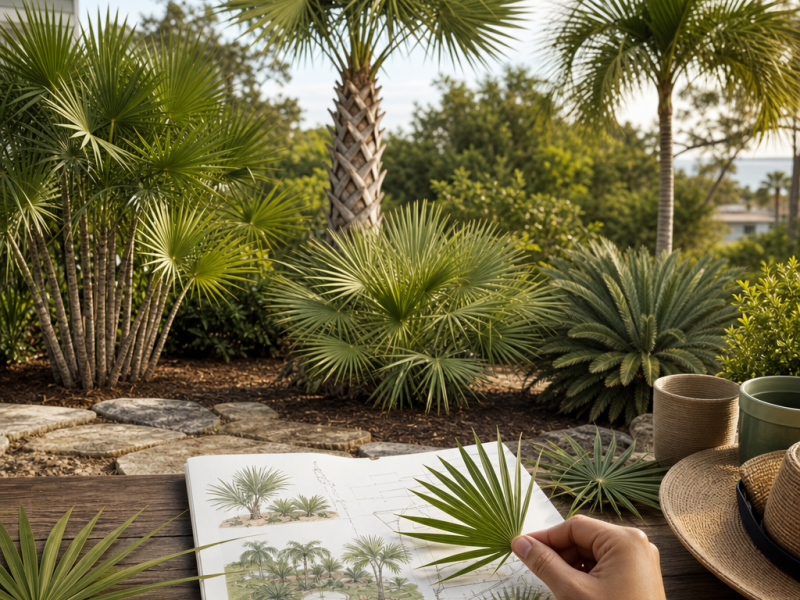
In professional landscape architecture, palms are often utilized as the primary “structural handwriting” of a project. Because they lack the secondary growth (thickening of the trunk via wood layers) of dicot trees, their mature form is remarkably predictable. This predictability allows a designer to map out sightlines, shadow patterns, and spatial volumes with a level of precision that is impossible with sprawling hardwoods. For a high-end property, the palm is a tool for sculpting the horizon, providing a sense of tropical rhythm that remains consistent through the seasons.
Why Should Professionals Pivot Toward Native Palm Trees in Florida?
While the temptation to use rare, exotic species is always present in luxury design, the long-term integrity of a site often depends on regional suitability. Integrating native palm trees in Florida into a master plan is a hallmark of an experienced architect who understands that a project’s success is measured in decades, not months. Native palms are the biological “insiders” of the peninsula; they are naturally tuned to the high-UV environment, the porous limestone substrates, and the specific rainfall cycles of the subtropics.
From a maintenance perspective, native species like the Cabbage Palm (Sabal palmetto) and the Silver Saw Palmetto (Serenoa repens) offer an “ecological autopilot” mode. They require significantly less supplemental irrigation once established and possess an innate ability to recover from the nutrient leaching that occurs during heavy summer rains. By grounding a design in native flora, you create a resilient framework that allows more delicate ornamental accents to thrive in the protected microclimates they provide.
Architectural Strategies: Framing and Proportion
The impact of a palm is determined by its relationship to the surrounding structures. A professional designer uses palms to solve specific architectural problems:
-
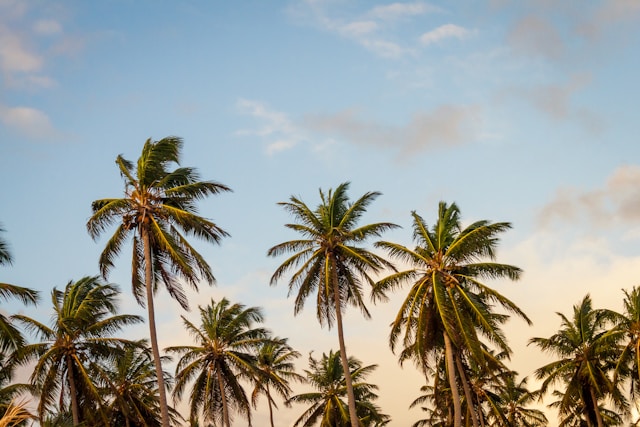
Softening Vertical Lines: Large-scale buildings with flat, modern facades can often feel cold or imposing. Planting tall, graceful palms like the Royal Palm or the Coconut Palm provides a living organic layer that breaks up the rigidity of the architecture without hiding the building’s design.
-
The “Ceiling” Effect: When palms are planted in tight clusters or rows, their interlocking fronds create a high-altitude canopy. This “living ceiling” makes large outdoor spaces feel more intimate and comfortable, as it filters the harsh overhead sun into a soft, dappled light.
-
Forced Perspective: In narrow lots, placing smaller palms in the foreground and progressively taller ones toward the back can trick the eye, making the property feel much deeper than its actual dimensions.
The Professional Standard: Specimen Selection and Sourcing
The difference between a commercial-grade landscape and a residential masterpiece often comes down to the quality of the nursery stock. In the wholesale world, “specimen quality” refers to more than just height; it encompasses the health of the apical meristem, the density of the root system, and the uniformity of the trunk.
A “pinched” trunk or yellowed spear leaf is a warning sign of poor cultivation. This is why top-tier designers rely on specialists like Treeworld Wholesale to source their material. When palms are grown under rigorous professional standards, they arrive on-site with the energy reserves necessary to survive the transplant process. Starting with a “Florida Grade #1” or better specimen ensures that the tree will not only survive but will immediately begin contributing to the property’s aesthetic value.
Designing for Extreme Weather: Wind and Salt
Florida designers must always account for the “hurricane factor.” Palms are among the most wind-firm plants in the world because their trunks are comprised of fibrous vascular bundles—similar to the structure of reinforced concrete—rather than brittle wood.
However, species selection still matters. The Sabal Palm is legendary for its ability to withstand 150+ mph winds by shedding its fronds to protect its “heart.” Coastal designers also prioritize salt tolerance; the Saw Palmetto and Florida Thatch Palm can handle direct salt spray and even occasional storm surge without suffering from salt-induced necrosis. By matching the palm’s physiological strengths to the site’s specific hazards, you ensure the landscape remains a permanent asset.
A Legacy of Form and Function
Ultimately, a palm is an investment in the “vertical real estate” of a property. As these trees mature, they become the defining characteristics of the skyline, providing shade, privacy, and architectural rhythm. By blending the rugged resilience of Florida’s native species with the statuesque beauty of select specimens, designers can craft environments that are both ecologically responsible and visually breathtaking. The result is a landscape that feels rooted in its environment while offering the timeless, elevated aesthetic of a world-class tropical sanctuary.